For many homeowners in 2026, the discovery of lead in their drinking water triggers an immediate and logical response: replace the faucet. It is a common assumption that if the “point of exit” is modern and certified lead-free, the water flowing from it must be safe. However, a significant number of residents are finding that even after installing high-end, compliant fixtures, their follow-up lab results still show detectable and sometimes elevated levels of lead. This frustrating reality highlights a critical truth about residential infrastructure: the faucet is only the final inch of a miles-long delivery system, and changing it often only scratches the surface of the problem.
If you have already upgraded your fixtures but are still seeing “fail” grades on your testing data, you haven’t necessarily bought a faulty product. Instead, you are likely dealing with legacy issues hidden deeper within your walls or beneath your property.
The “Lead-Free” Paradox
The first thing to understand is the legal definition of “lead-free.” Under current federal regulations, a fixture can be labeled lead-free even if it contains up to 0.25% lead on its wetted surfaces. While this is a massive improvement over the fixtures of the 1980s, which could contain up to 8% lead, it is not “zero.”
In a brand-new fixture, there can be a “breaking-in” period where trace amounts of lead from the manufacturing process or the internal brass components leach into the water. If you test your water the day after a new installation, you might catch this initial spike. However, if the lead persists weeks later, the source is almost certainly further up the line.
The Solder and the “Galvanic” Connection
The most common culprit for persistent lead in modern homes is the plumbing behind the wall. Even if you have copper pipes, those pipes were likely joined with lead-based solder if your home was built or renovated before the late 1980s.
When you install a brand-new, highly conductive brass fixture onto old copper pipes, you can sometimes create a “galvanic” cell. The different metals, combined with the water acting as an electrolyte, can actually accelerate the corrosion of the old lead solder nearby. This means your new faucet might be indirectly causing more lead to leach from the pipes immediately behind it. This is a common theme we explore in our blog, where we discuss how modern upgrades can sometimes “awaken” legacy contaminants.
The Service Line: The Buried Liability
If you have replaced every fixture and every visible pipe in your home but lead remains, the problem likely lies under your front lawn. The service line the pipe that connects your home to the municipal water main is the single largest source of lead in urban and older suburban environments.
In many local areas, these service lines are made of pure lead. Because they are buried deep underground, they are often forgotten during interior renovations. A new kitchen faucet cannot filter out the lead that is being picked up as the water travels through thirty feet of lead piping from the street to your house. Until that service line is replaced, any fixture-level upgrade is essentially a cosmetic fix for a structural problem.
The “Particulate Lead” Trap
Lead doesn’t always enter your water as a dissolved liquid; it often travels as tiny, microscopic “slugs” of physical debris. When a plumber removes an old faucet to install a new one, the physical jarring and the change in water pressure can dislodge “lead scale” from the interior of the pipes.
These heavy particles can settle in the “dead legs” of your plumbing or get trapped in the aerator of your brand-new faucet. If you test the water without cleaning the aerator, you might be measuring the lead that was knocked loose during the installation rather than the water quality itself. This is why we always recommend a thorough system flush and a second look at the testing data a few weeks after any plumbing work is completed.
Galvanized Pipes and Lead “Sequestration”
If your home has (or used to have) galvanized steel pipes, you may be dealing with a “sponge” effect. Galvanized pipes are notorious for rusting from the inside out, creating a jagged, porous interior surface. Over decades, if lead was present in the water (from a service line or solder), those rust layers “absorbed” the lead.
Even if you replace the galvanized pipes with modern PEX or copper, any remaining segments of old pipe can continue to “shed” lead into the water for years. This “sequestration” makes lead removal a long-term process rather than a one-day fix. On our blog, we often advise homeowners on how to identify these “legacy sponges” within their home’s infrastructure.
The Role of Water Chemistry: pH and Corrosivity
Sometimes, the lead isn’t coming from a “failed” pipe, but from a change in the water itself. If your water is slightly acidic (low pH), it will aggressively eat away at whatever lead remains in your system, no matter how small.
If your municipality changes its treatment process or if your private well’s chemistry shifts due to seasonal rain, the water may become more “hungry” for metals. In this scenario, your new fixture isn’t the problem; the water’s “corrosivity” is. Without balancing the pH, even the most expensive lead-free fixtures won’t prevent leaching from the older components hidden in the walls. Understanding the regulations surrounding water corrosivity is a key part of interpreting your lab results.
How to Find the “Real” Source
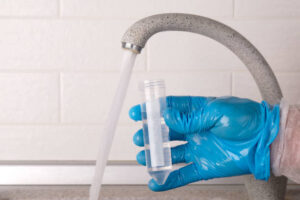
If your new fixture didn’t solve the problem, you need to perform a “diagnostic” flush and test. This involves a three-tiered sampling approach: The First Draw: Sample the very first water out of the tap after it has sat overnight. This captures lead from the fixture and the immediate pipes. The Two-Minute Flush: Run the water for two minutes, then sample. This captures water that was sitting in the “vertical” pipes and the service line. The Five-Minute Flush: Run the water for five minutes, then sample. This represents the water coming directly from the city main.
By comparing these three sets of testing data, you can pinpoint exactly where the lead is entering the stream. If the lead is only in the “First Draw,” the issue is local (solder or the fixture). If it’s in the “Two-Minute Flush,” the service line is the culprit.
Conclusion: Moving Toward a Total Solution
Replacing a fixture is a great first step, but it is rarely the final one in an older home. Lead is a persistent and mobile contaminant that requires a holistic view of your home’s infrastructure. In 2026, we have the tools to be precise don’t let a single “pass” or “fail” report discourage you. Instead, use that data to map out the next stage of your home’s remediation.
Whether the answer is a service line replacement, a whole-house neutralizing system, or simply a high-capacity filter at the kitchen sink, the solution starts with knowing the source.
If you have upgraded your plumbing but are still concerned about lead levels in your home, or if you need help interpreting a multi-stage “flush test” report, our team is ready to assist. We provide the certified analysis and expert guidance needed to track down the source of persistent contamination. Please visit our contact page to connect with a water quality specialist today. Let us help you ensure that your “lead-free” home is a reality, not just a label.