For many homeowners, the allure of a prewar home is undeniable. These structures, typically built before 1945, offer a level of craftsmanship, architectural detail, and historical character that modern builds struggle to replicate. From hand-carved moldings to thick plaster walls, they feel permanent and storied. However, that same sense of permanence applies to the home’s hidden infrastructure. While the aesthetic elements of a prewar home age gracefully, the metal plumbing systems within the walls do not. In 2026, as we gain more sophisticated testing data, it is becoming clear that these historic residences are significantly more prone to metal leaching than their modern counterparts.
Understanding why older homes act as a “source” for heavy metals requires a look at the history of plumbing materials and the chemistry of aging metals. If you are living in a prewar home, the water in your glass is traveling through a timeline of industrial history one that often includes lead, copper, and galvanized steel.
The Era of the Lead Service Line
The most significant risk factor for prewar homes is the service line the pipe that connects the home to the municipal water main in the street. From the late 1800s through the mid-1940s, lead was the “gold standard” for service lines. It was favored by plumbers for its malleability; it could be easily bent around tree roots and foundation stones without breaking.
Because these lines are buried deep underground, they are rarely replaced during interior renovations. Even if a homeowner has updated every faucet and pipe inside the house, they may still be drinking water that has sat stagnant in thirty feet of pure lead piping overnight. This is why we often see in our blog that interior renovations alone aren’t enough to secure a “pass” on a water test in older neighborhoods. For prewar homes, the source of leaching often starts before the water even reaches the foundation.
Galvanized Steel and the “Lead Sponge” Effect
Many prewar homes utilized galvanized steel for their internal distribution lines. These are iron pipes coated in a layer of zinc to prevent rust. While effective for a few decades, that zinc coating eventually erodes, exposing the iron beneath to the water. This leads to the “red water” or metallic taste many old-home owners recognize.
However, the real danger is more subtle. In 2026, researchers have confirmed that old galvanized pipes act as a “lead sponge.” Over many decades, if lead was present in the service line or the city mains, the porous rust layers inside the galvanized pipes “sequestered” or absorbed those lead particles. Even if the original lead source is removed, these pipes can continue to “shed” lead back into the water for years. This legacy contamination is a primary reason why older homes continue to show elevated metal levels in their testing data long after municipal upgrades are complete.
The Complexity of Mixed-Metal Systems
Prewar homes are rarely “pure” in their plumbing. Over eighty or one hundred years, they have been patched, repaired, and expanded. A single home might contain original galvanized lines, 1960s copper segments, and 2026 PEX plastic additions. While these repairs are necessary, connecting dissimilar metals creates an electrochemical environment known as “galvanic corrosion.”
When a more “noble” metal like copper is connected directly to a less noble metal like galvanized steel, the steel begins to corrode at an accelerated rate. This reaction acts as a catalyst for metal leaching. The water becomes an electrolyte, facilitating a battery-like reaction that pulls metal ions out of the pipe walls and into the drinking stream. For residents, this means that a “partial” plumbing upgrade can sometimes make the leaching of the remaining old pipes worse than it was before. Understanding how these regulations and chemical interactions work is essential for anyone planning a renovation in an older building.
Lead Solder and the “50/50” Rule
Even when prewar homes were updated to copper plumbing in the mid-century, they weren’t necessarily “lead-free.” Until the federal ban in 1986, the most common material used to join copper pipes was “50/50 solder” a mixture that was 50% lead and 50% tin.
Because copper is a highly conductive metal, it effectively pulls lead out of the solder joints through a process called “surface leaching.” In a large prewar home with hundreds of joints, the cumulative surface area of that lead solder is substantial. When the water sits stagnant such as when a family is at work or asleep the concentration of lead at those joints increases. This is a common finding in local water profiles: the “first-draw” sample is often the most contaminated because it has had the most “contact time” with these legacy solder joints.
The Impact of Water Chemistry on Aging Infrastructure
The rate at which a prewar home leaches metal isn’t just a function of the pipes themselves; it’s also a function of the water chemistry. “Soft” water or water with a low pH (acidic) is naturally more aggressive. It acts as a solvent, stripping metals from the interior of the plumbing.
In many older cities, the water chemistry is carefully managed with corrosion inhibitors like orthophosphate, which creates a protective “scale” or coating inside the pipes. However, if that chemistry shifts or if a homeowner installs a water softener that makes the water more aggressive that protective coating can be stripped away, exposing the legacy lead and iron beneath. This is why we emphasize in our blog that water safety in an old home is a delicate balance between the pipes and the fluid moving through them.
How to Manage a Prewar Plumbing System
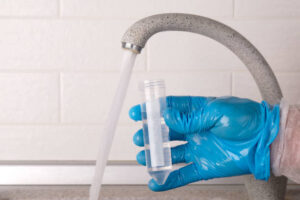
If you own or rent a prewar home, you shouldn’t panic, but you should be proactive. Here is how to manage the risk of metal leaching: The Sequential Test: Don’t just take one sample. Take a “first-draw” (from the faucet), a “two-minute flush” (from the internal pipes), and a “five-minute flush” (from the service line). This allows you to pinpoint where the metals are coming from. Identify the Service Line: Check your basement where the water pipe enters the foundation. If the pipe is a dull grey, soft, and turns shiny when scratched with a screwdriver, it is lead. Update Wisely: If you are replacing a section of pipe, try to replace the entire run. If you must connect copper to steel, ensure your plumber uses a “dielectric union” to prevent galvanic corrosion. Install Point-of-Use Filtration: For most prewar homes, an under-sink Reverse Osmosis system or a filter certified for lead (NSF/ANSI 53) is the most effective way to ensure immediate safety at the kitchen tap.
Conclusion: Stewardship of the Historic Home
Living in a prewar home is a form of stewardship. We take care of the floors, the windows, and the facade to preserve the past. In 2026, we must extend that stewardship to the home’s infrastructure. Metal leaching is a natural consequence of aging materials, but it is not an unsolvable problem.
By using modern testing data to understand what is happening inside your walls, you can protect your family while enjoying the unique character of your historic residence. The goal isn’t to fear the old pipes, but to manage them with the precision that modern science allows.
If you are concerned about the age of your plumbing and want to establish a baseline for lead or copper leaching, our team is ready to help. We provide the certified analysis and expert interpretation needed to identify the unique challenges of prewar systems. Please visit our contact page to connect with a water quality specialist today. Let us help you ensure that your historic home provides a healthy future.